
PBN Crucible Cracking: Troubleshooting & Lifetime Optimization
In high-temperature vacuum processes such as MBE, PBN (Pyrolytic Boron Nitride) crucibles are essential for their high purity and low outgassing. However, PBN crucible cracking remains a critical field failure that leads to contamination and unplanned downtime.
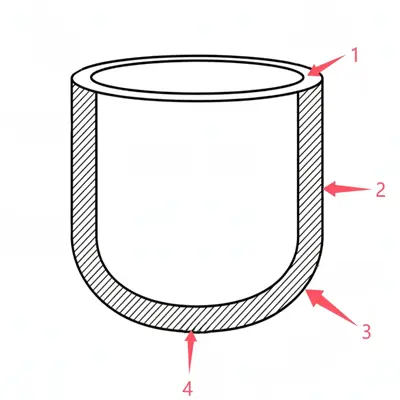
- Zone 1: Rim / upper edge
- Zone 2: Side wall mid section
- Zone 3: Bottom corner fillet
- Zone 4: Bottom center
1) Thermal Shock and Gradients (Zones 1 / 2 / 3)
While PBN has excellent thermal shock performance, it is sensitive to rapid temperature shifts. Aggressive heating ramps, forced cooling, or uneven heat fields create massive internal stress.
- Corrective Actions: Slow down ramp rates and avoid forced quenching. Check radiation shield alignment to ensure a uniform heat field.
2) Structural Stress and Geometric Weak Points (Zones 1 / 3 / 4)
Cracks often initiate where geometry changes abruptly. Small radii at the bottom corner (Zone 3) or sudden wall thickness variations are primary PBN crucible cracking triggers.
- Corrective Actions: Increase corner radii and design gradual thickness transitions to eliminate stress concentrators.
3) Clamping Constraints and Local Overheating
Rigid clamping prevents necessary thermal expansion, leading to mechanical failure (Zones 2 / 3 / 4). Furthermore, localized hot spots caused by off-center crucible positioning can create severe thermal gradients.
- Corrective Actions: Ensure symmetric support with expansion clearance. Center the crucible within the heating zone and verify shield integrity.
4) Contamination and Cleaning Risks
Surface contamination or improper mechanical scraping can cause localized stress amplification. These micro-cracks expand during subsequent thermal cycles (Zones 1 / 4).
Technical Advice for PBN Crucible Lifetime
Extending the service life of your PBN components is a matter of stress control.
Technical Director: Zhang Gong
Tel / WeChat: +86-18602175437
Email: telice@teliceramic.com
Website: teliteceramic.com