
Hall Thruster Discharge Channel Materials: Engineering & Selection
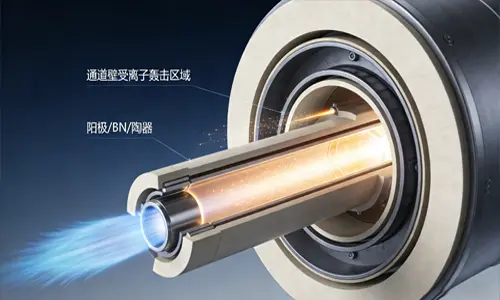
The discharge channel is the heart of a Hall thruster and operates under some of the harshest conditions in satellite electric propulsion. High-energy ion bombardment, electron dynamics, and intense thermal loads converge here, making material selection critical for efficiency, stability, and lifetime.
1) Core Engineering Concerns: Sputter Erosion & Lifetime
Continuous ion bombardment causes wall erosion, leading to significant system drift:
- Geometry Drift: Erosion alters the channel shape, shifting discharge and magnetic-field interactions.
- Contamination: Sputtered species can deposit on downstream components, affecting solar arrays or plume signatures.
Takeaway: Engineers must prioritize materials with a low sputter yield and stable surface behavior under specific power levels and propellant types (e.g., Xenon, Krypton).
2) Electrical Stability: SEE and Potential Distribution
In high-energy electron environments, the dielectric response of the material is paramount. Key considerations include:
- Secondary Electron Emission (SEE): High SEE產額 can significantly lower discharge efficiency.
- Surface Charge: Materials must manage charge accumulation and dissipation to maintain a stable potential distribution.
- Impurity Management: Conductive phases or trace impurities can unbalance the electrical design.
3) Thermal Management: Preventing Cracks and Erosion Spikes
Strong temperature gradients and local hot spots often lead to thermal expansion mismatch. If cracks occur, erosion accelerates rapidly.
| Key Property | Impact on Performance |
|---|---|
| Thermal Conductivity | Dissipates heat from local plasma hot spots. |
| CTE (Thermal Expansion) | Determines the assembly fit during high-temperature cycles. |
| Thermal Shock Resistance | Prevents micro-cracks and edge chipping during startup/shutdown. |
4) Purity and Vacuum Compatibility
In the sensitive plasma environment, even trace outgassing from binders or volatile residues can lead to operating point drift or “surface poisoning”. Predictable behavior requires high purity and a dense microstructure.
5) Batch Consistency and Reliability
Small variations in porosity or surface finish between batches can lead to unexplainable results in sensitive Hall thrusters. Technical verification should always combine target property ranges with actual sample testing.
Advanced Solutions for Electric Propulsion
At Telite Ceramics, we provide BN-based and composite materials engineered for high-stability thruster channels.
Technical Director: Zhang Gong
Tel / WeChat: +86-18602175437
Email: telice@teliceramic.com
Website: teliteceramic.com