
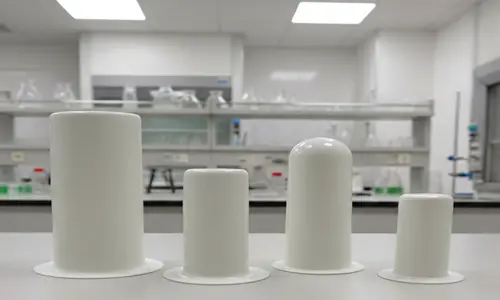
PBN crucibles (Pyrolytic Boron Nitride) are widely used in vacuum evaporation, thin film deposition, and high-purity thermal processes because they offer low outgassing, high purity, and stable performance at high temperature.
Yet in real production, lifetime can vary dramatically: the same crucible design may last a long time in one tool, but crack, spit, or contaminate after only a few runs in another. In many cases, the difference is not the PBN itself—it’s the usage details.
Below are 7 practical, engineering-level details that often make PBN crucibles last noticeably longer and reduce maintenance cost.
1) Pre-bake: Solve Outgassing and Thermal Shock Before the Process Starts
Goal: remove residual moisture/organics, reduce early-stage outgassing and sudden “spitting”, and bring the crucible + holder into a stable thermal state.
Practical approach (general logic):
- For a new crucible or long storage: run a gentle, low-temperature pre-bake with a controlled ramp before going to full process power.
- Before each run: include a short pre-heat step so the crucible, hearth/holder, and fixtures warm up together.
Common mistakes:
- Going to high power immediately → large temperature gradients → stress concentration and cracking risk.
- Pre-baking while solvents/volatile contamination are still present in the chamber → contamination can “bake onto” surfaces.
2) Cleaning: Over-cleaning Can Remove Lifetime Faster Than Deposits Do
PBN surfaces are dense and stable, but wrong cleaning methods can introduce micro-scratches, re-contaminate the surface, or leave residues—creating future crack initiation sites or particle sources.
Recommended practice:
- Light contamination (dust/fingerprints): use lint-free wipes with anhydrous ethanol or IPA, then let it fully evaporate.
- Stubborn residues: identify the residue type first (oxide/metal/organic). Avoid aggressive scraping. A mild heat step may help loosen deposits before removal.
- After cleaning: ensure the crucible is completely dry before vacuum use (moisture = outgassing + spitting risk).
Avoid:
- Sandpaper, steel brushes, hard metal scrapers → scratches and stress raisers.
- Tap water rinse without proper drying → ionic residues can cause problems in vacuum and at temperature.
3) Fill Level: Overfilling Is a Top Cause of Wetting, Spitting, and Contamination
Many “crucible failures” are actually caused by charge behavior rather than crucible quality. If the fill height is too high, the molten pool has less margin for bubbling/rolling, and overflow becomes more likely.
Practical rules:
- Keep the charge well below the rim, especially for low-viscosity or easily foaming materials.
- Leave enough headspace for molten movement to avoid rim wetting and overflow.
Typical symptoms when fill level is too high:
- Rim build-up and flow marks on the outer wall → “bridging” and higher thermal stress → shorter lifetime.
- Sudden particle spikes on the film → often linked to spitting/splashing events.
4) Rim Chamfer: A Small Chamfer Can Create a Safer, More Stable Edge
Sharp edges at the rim are classic stress concentrators and also easier to wet and build up deposits. A proper chamfer or small radius often improves reliability.
Why it helps:
- Reduces thermal stress concentration and crack initiation probability.
- Reduces the chance of deposit “bridging” at sharp corners.
Recommendation:
- If your process repeatedly cracks rims or shows rim build-up, consider a factory-made chamfer/radius design.
- Avoid rough, uncontrolled manual grinding on-site (irregular chips can be worse than a sharp edge).
5) Ramp Profile: Don’t Chase “Fast”—Chase “Stable”
PBN performs very well at high temperature, but that does not mean it tolerates aggressive ramps without penalty. Many cracks are triggered by temperature gradients rather than absolute temperature.
Recommended strategy:
- Use a staged ramp: low power stabilization → mid power stabilization → process power.
- Add short soak/stabilization time between stages to allow thermal equalization.
- If the holder has large thermal mass or complex clamping, thermal synchronization becomes even more important.
Common failure pattern:
- “Full power immediately” → bottom heats first, walls lag → cracks often start at the rim or bottom corner.
6) Mounting & Contact Surfaces: Poor Contact = Local Hot Spot = Cracks
A PBN crucible is not a “drop-in part.” Small issues in the holder interface can create localized stress and hot spots.
Checklist:
- Is the crucible bottom fully seated? Any tiny particle trapped between crucible and holder?
- Is the clamp too tight (restricts thermal expansion and can “lock” the crucible)?
- Any wobble or point contact that becomes off-axis loading when hot?
Practical note: Many “mysterious cracks” trace back to a single grain of debris, a small high point, or uneven clamping.
7) Shutdown & Cool-down: Many Crucibles Don’t “Fail in Use”—They Fail During Cooling
Shutdown is part of the process. Thermal shock during cool-down can damage PBN just as effectively as a bad ramp-up.
Best practice:
- Reduce power gradually (avoid abrupt thermal transitions).
- Wait until the system temperature drops significantly before opening the chamber or touching the crucible.
- Avoid moving the crucible while it is still hot (thermal stress + mechanical stress = hidden cracks).
Avoid:
- Immediate venting and cold gas exposure right after shutdown.
- Hot handling or bumps—micro-cracks can expand in the next run.
One-Line Summary
To extend PBN crucible lifetime, focus on: lower outgassing and contamination → control charge behavior (no rim wetting / no overflow) → reduce stress concentration (chamfer + stable ramps + proper mounting) → avoid thermal shock (pre-bake and controlled cool-down).
If you tell us what materials you evaporate (e.g., Al, Au, Ag, Ni, Pd, oxides, etc.), we can help translate these 7 points into a more process-specific checklist: typical failure modes, recommended charge strategy, and whether a lid/liner/shield ring design is worth considering.
Contact:
Tel / WeChat: 18602175437
Email: telice@teliceramic.com
Xiamen, China