
Boron Nitride Coating (Water-Based High-Temperature Anti-Sticking & Release Coating)
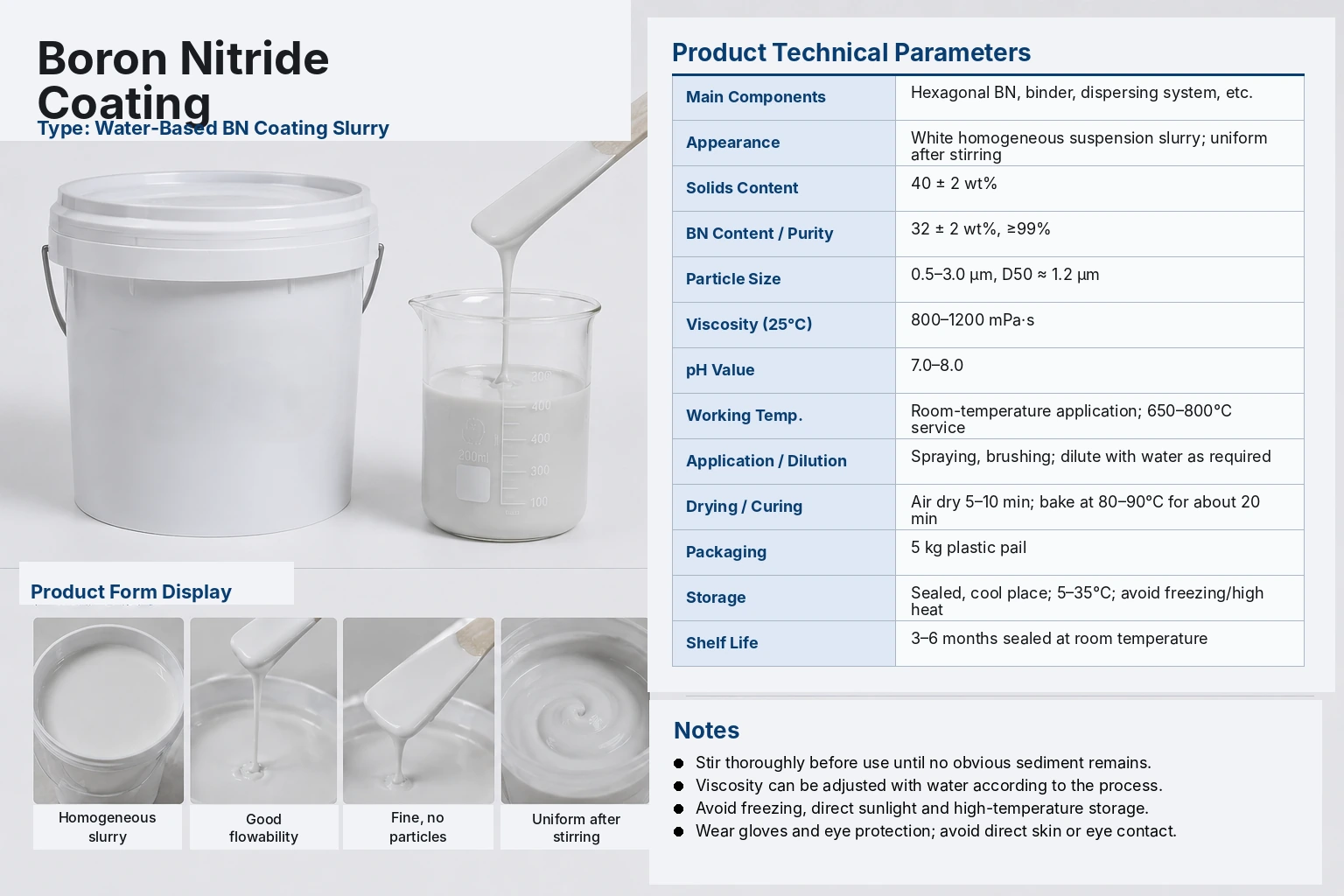
Boron Nitride Coating is a water-based high-temperature functional coating slurry using hexagonal boron nitride (h-BN) as the main functional phase. After application and drying, it forms a white, uniform and inert barrier layer on graphite, ceramic, metal or refractory surfaces.
The main purpose of BN coating is to reduce adhesion, contamination, reaction and surface damage under high-temperature conditions. It is commonly used for anti-sticking, release, thermal insulation, lubrication and surface protection in graphite crucibles, furnace components, metal molds, vacuum equipment parts and high-temperature process fixtures.
Xiamen Telite New Materials Co., Ltd. can adjust the solids content, BN ratio, viscosity, flow behavior, binder system, coating adhesion, particle fineness and dilution ratio according to the customer’s actual working conditions. Different formulations can be matched with spraying, brushing, dipping, rolling or local repair processes.
1. What Is Boron Nitride Coating?
Boron nitride coating is a water-based BN slurry made from hexagonal boron nitride powder, binder, dispersing system, water-based carrier and other auxiliary additives. Hexagonal boron nitride has a layered crystal structure, good thermal stability, chemical inertness, lubricity and low wettability to many molten materials.
In practical use, BN coating is not simply BN powder mixed with water. A stable coating slurry requires proper dispersion, rheology control and binder design, so that the BN powder can remain uniformly suspended and form a continuous coating layer on the substrate surface.
In simple terms, boron nitride coating works as an inert barrier layer between the substrate and high-temperature materials, helping reduce sticking, reaction, corrosion, slagging and contamination.
2. Technical Parameters
| Product Name | Boron Nitride Coating / Water-Based BN High-Temperature Release Coating |
| Main Components | Hexagonal BN, binder, dispersing system, water-based carrier, etc. |
| Appearance | White homogeneous suspension slurry; uniform after stirring |
| Solids Content | Standard grade approx. 40 ± 2 wt%; adjustable according to process requirements |
| BN Content | Standard grade approx. 32 ± 2 wt%; adjustable for release, isolation and lubrication requirements |
| BN Powder Purity | ≥99% |
| Particle Size | 0.5–3.0 μm, D50 approx. 1.2 μm |
| Viscosity at 25°C | Standard grade approx. 800–1200 mPa·s; adjustable for spraying, brushing or dipping |
| pH Value | 7.0–8.0 |
| Recommended Working Temperature | Approx. 650–800°C, depending on atmosphere, substrate, coating thickness and binder system |
| Application Methods | Spraying, brushing, dipping and rolling; dilution can be adjusted with water |
| Packaging | Standard 5 kg plastic pail; customized packaging is available upon request |
| Storage | Sealed storage at 5–35°C; avoid freezing, direct sunlight and high-temperature storage |
3. Custom Formulation According to Customer Requirements
Different customers often need different coating behavior. Some applications require better spray atomization, while others require thicker brushing layers, stronger adhesion after drying, lower powder shedding, easier cleaning or better high-temperature release performance.
Therefore, boron nitride coating can be adjusted according to the actual substrate, temperature, atmosphere, coating thickness and application method.
| Adjustable Item | Purpose of Adjustment |
| Solids Content | Affects coating thickness, coverage rate, drying speed and application viscosity |
| BN Ratio | Affects anti-sticking, release, isolation, lubrication and high-temperature protection performance |
| Viscosity | Helps match spraying, brushing, dipping, rolling or local repair processes |
| Binder System | Improves coating adhesion and reduces powder shedding or cracking after drying |
| Particle Fineness | Affects coating smoothness, surface uniformity and application stability |
| Dilution Ratio | Adjusts flowability and coating thickness according to on-site process requirements |
If the customer has specific requirements for substrate material, operating temperature, atmosphere, coating thickness, adhesion or application method, we recommend providing the actual working conditions first. We can then recommend a suitable BN coating grade for testing.
4. Slurry Condition, Flowability and Fineness
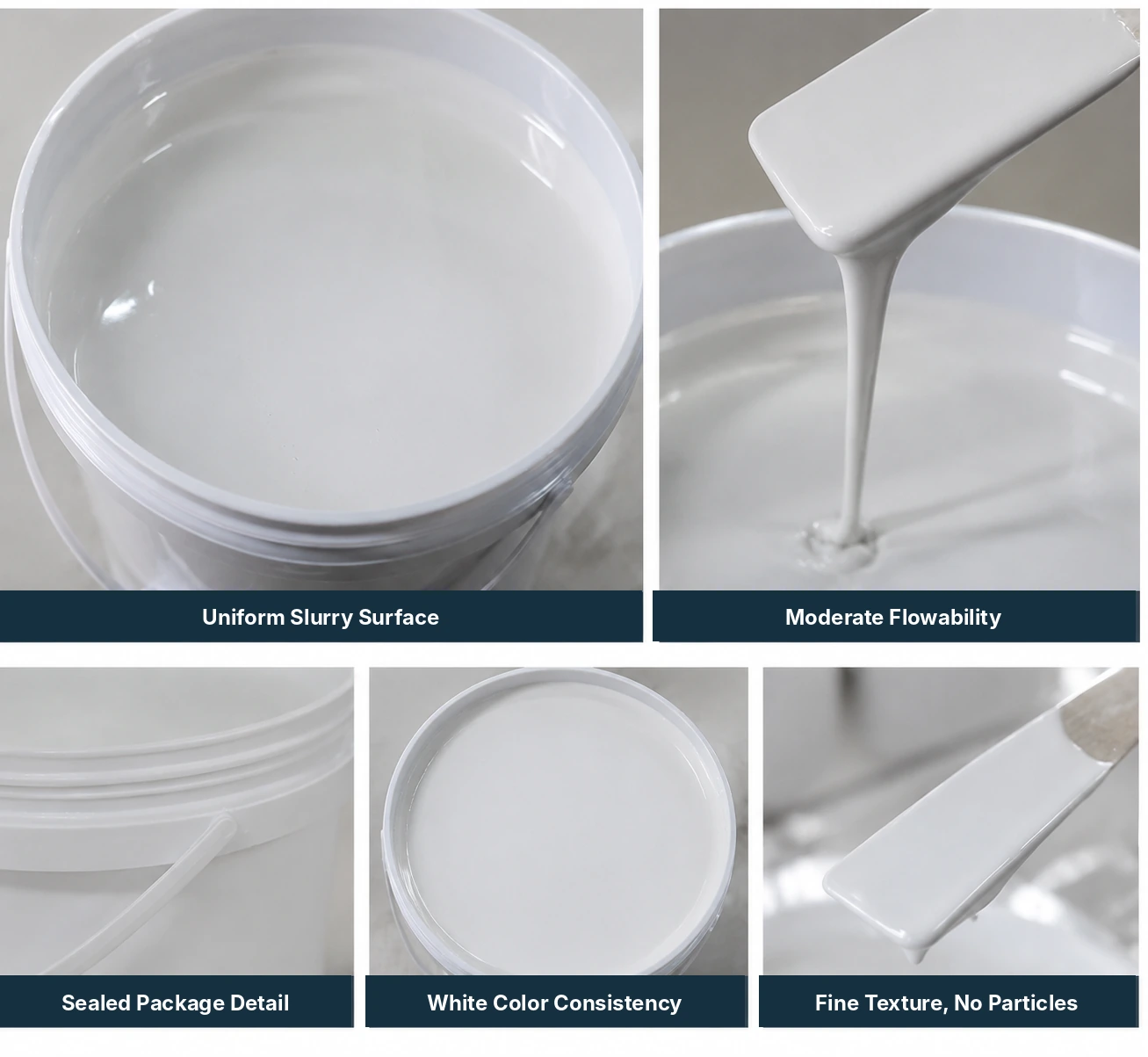
This product is a white homogeneous suspension slurry with a fine and smooth appearance under normal conditions. Before use, it should be fully stirred until the slurry becomes uniform. A small amount of sedimentation or separation after long-term storage is normal for water-based BN slurry and does not mean the product has failed.
The slurry condition can be adjusted for different application methods:
- Spraying: lower viscosity and better flowability are usually required for uniform atomization.
- Brushing: higher viscosity can improve coating build-up and surface coverage.
- Dipping: controlled flow behavior helps avoid excessive coating thickness or sagging.
- Local repair: higher-viscosity grades can improve local coverage and adhesion.
5. Why Use Boron Nitride Coating in High-Temperature Applications?
In high-temperature industrial processes, graphite, ceramic, metal molds and furnace parts may face problems such as material sticking, molten material penetration, oxidation, reaction contamination, slagging and difficult cleaning. BN coating helps form a low-surface-energy barrier layer on the substrate surface, reducing direct contact between the substrate and high-temperature materials.
The main functions of boron nitride coating include:
- Reducing adhesion of molten metals, glass, salts, oxides or other high-temperature materials
- Reducing penetration and contamination on graphite, ceramic or metal surfaces
- Improving release performance and reducing cleaning frequency
- Reducing slagging and surface contamination on furnace components
- Providing thermal insulation, lubrication and surface protection under suitable working conditions
- Improving maintenance convenience and service stability of high-temperature equipment parts
The actual service life of the coating depends on temperature, atmosphere, substrate material, coating thickness, binder system and working cycle. For vacuum, high-purity, semiconductor or continuous high-temperature applications, sample testing is recommended before batch use.
6. Production and Quality Control
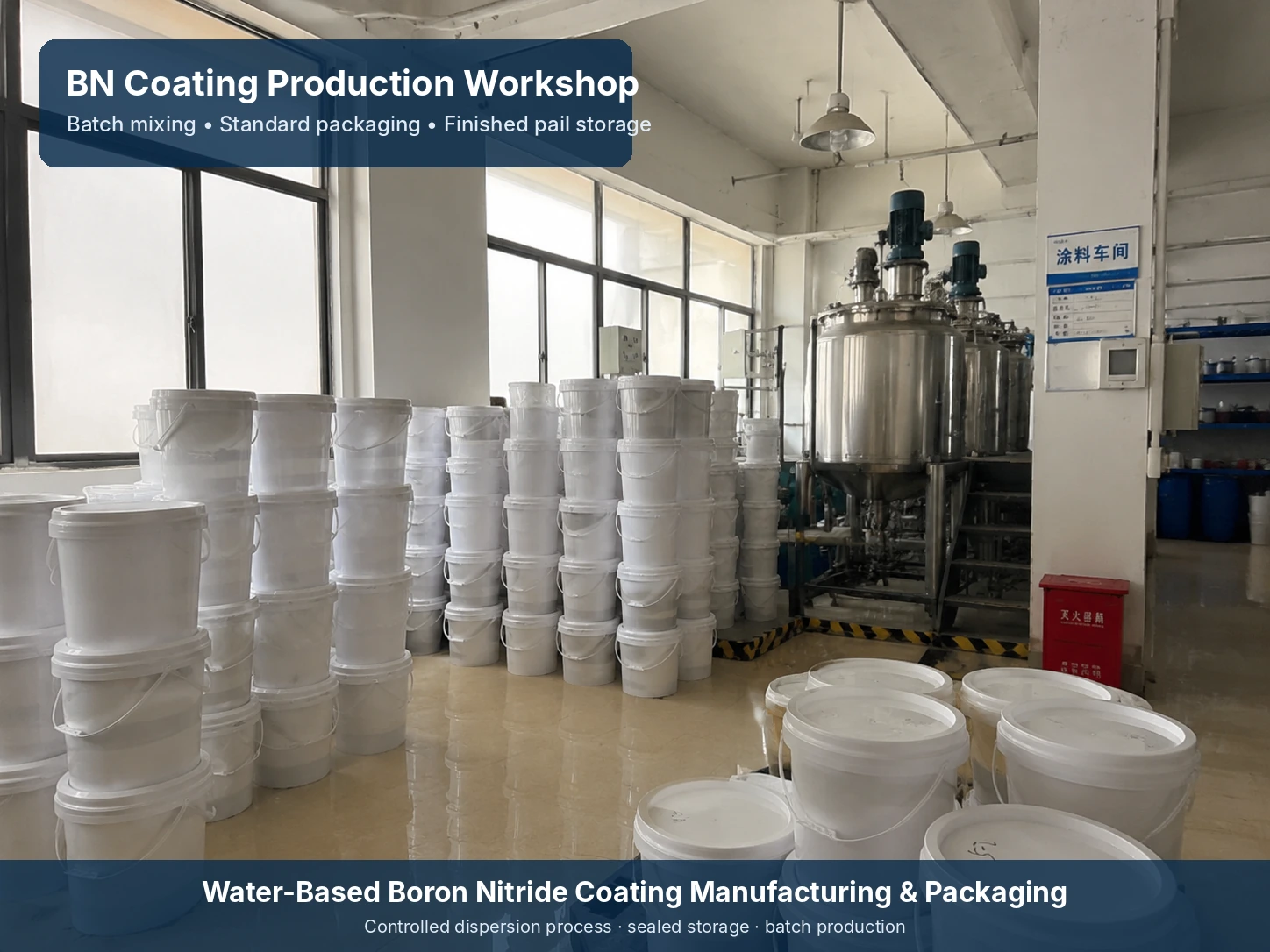
The stability of boron nitride coating is closely related to BN powder purity, particle size distribution, dispersion uniformity, binder system and homogenization process. During production, key factors such as slurry fineness, viscosity range, solids content stability and batch consistency need to be controlled.
Our production control focuses on the following items:
- BN powder purity and particle size distribution
- Uniform dispersion of the slurry
- Solids content and viscosity stability
- Coated surface condition after application
- Adhesion and powder shedding after drying
- Packaging sealing and storage stability
7. Typical Applications
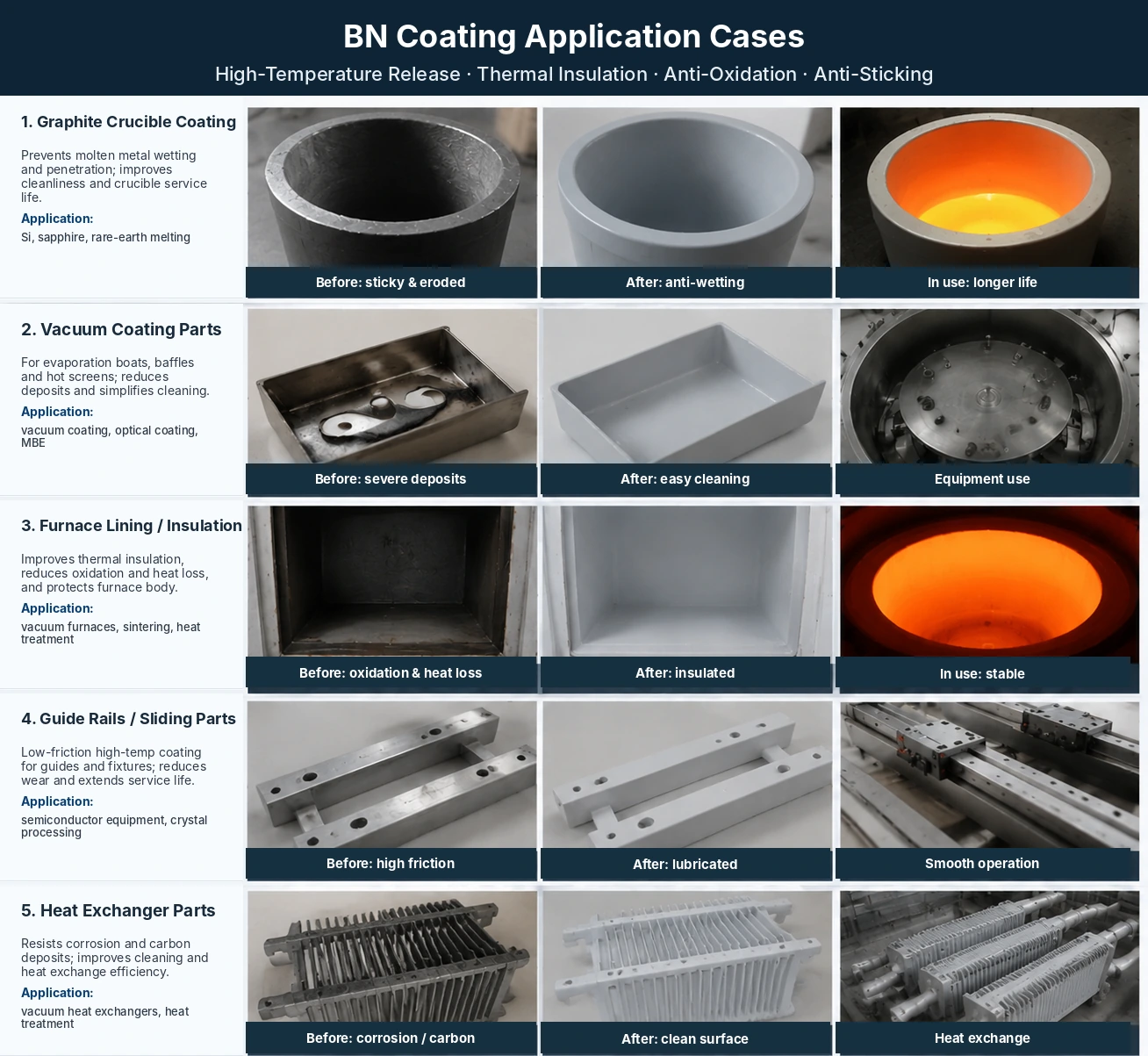
Boron nitride coating is suitable for many high-temperature industrial applications, especially where anti-sticking, release, thermal insulation, lubrication or surface isolation protection is required.
| Application Area | Main Function |
| Graphite Crucibles and Graphite Molds | Reduces molten material penetration, sticking and graphite surface contamination |
| Vacuum Coating Equipment Parts | Reduces material deposition and makes later cleaning and maintenance easier |
| Furnace Linings and Insulation Layers | Reduces furnace contamination and improves thermal insulation protection |
| Metal Melting and Casting Molds | Improves release performance and reduces metal sticking |
| Ceramic and Refractory Surfaces | Forms an isolation coating and reduces high-temperature reaction contamination |
| Guide Rails and Sliding Parts | Provides lubrication and friction reduction under specific working conditions |
| Heat Exchanger Components | Helps reduce surface deposits and improves cleaning convenience |
8. Application and Use Method
Before use, the BN coating should be fully stirred until the slurry is uniform and no obvious sedimented lumps remain. The dilution ratio, coating thickness and drying condition should be adjusted according to the actual application method and substrate.
- Substrate preparation: remove oil, dust, oxide scale or loose particles from the surface before coating.
- Stirring: stir thoroughly before use until the slurry becomes uniform.
- Dilution: add water properly to adjust viscosity according to spraying, brushing or dipping requirements.
- Coating: multiple thin layers are usually more stable than one very thick layer.
- Drying: after surface drying for about 5–10 minutes, it can be baked at 80–90°C for about 20 minutes.
- Testing: sample testing on the same or similar substrate is recommended before batch use.
Actual drying time, coating thickness, dilution ratio and service life should be adjusted according to substrate material, equipment structure, temperature, atmosphere and customer process requirements.
9. Storage and Handling Notes
- Store in a sealed container in a cool and dry environment. Recommended storage temperature: 5–35°C.
- Avoid freezing, direct sunlight and long-term high-temperature storage.
- Stir thoroughly before use after long-term storage.
- Avoid violent vibration during transportation and storage.
- Wear gloves, mask and goggles during application to avoid direct contact with skin and eyes.
- For vacuum, high-purity, semiconductor or special atmosphere applications, sample verification is recommended before formal use.
10. FAQ
Q1: Does boron nitride coating settle during storage?
A: Slight sedimentation is normal for water-based BN slurry. It can usually return to a uniform state after sufficient stirring before use.
Q2: Can the BN coating formulation be customized?
A: Yes. We can adjust solids content, BN ratio, viscosity, binder system, adhesion, particle fineness and dilution ratio according to the customer’s substrate, temperature, atmosphere and application method.
Q3: Are spraying-grade and brushing-grade BN coatings the same?
A: The main composition can be similar, but the slurry condition is different. Spraying usually requires better flowability and atomization, while brushing focuses more on coating build-up, coverage and adhesion.
Q4: Will the coating shed powder after drying?
A: Powder shedding is related to the binder system, substrate surface treatment, coating thickness and drying process. For applications requiring higher adhesion, an enhanced binder version can be selected.
Q5: Can boron nitride coating be used in vacuum equipment?
A: It can be used for anti-sticking and isolation protection on some vacuum high-temperature equipment surfaces. However, suitability depends on vacuum level, temperature, outgassing requirements and cleanliness requirements. Sample testing is recommended.
Q6: What is the recommended working temperature of BN coating?
A: The standard recommended working temperature is about 650–800°C. The actual usable temperature depends on atmosphere, substrate, coating thickness, service cycle and binder system.
Q7: What information should customers provide before choosing a BN coating grade?
A: Customers can provide substrate material, working temperature, atmosphere, application method, vacuum condition, coating thickness requirement, and whether the coating will contact molten metal or other high-temperature materials.
11. Product Summary
Boron nitride coating is a water-based BN functional coating material for high-temperature anti-sticking, release, thermal insulation, lubrication and surface protection. It can be supplied as a standard coating slurry or adjusted according to specific working conditions, including solids content, BN ratio, viscosity, binder system, adhesion and application compatibility.
For applications with special temperature, atmosphere, cleanliness, adhesion or coating thickness requirements, sample testing is recommended before batch use to confirm coating performance and process compatibility.
-300x225.webp)
-300x225.webp)

Reviews
There are no reviews yet.