
Alumina Crucible Ni Pd Evaporation: Reducing Spitting & Adhesion
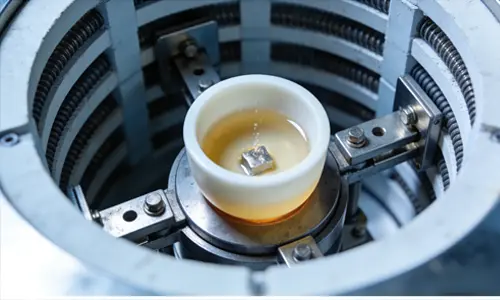
Nickel (Ni) and Palladium (Pd) are often considered “difficult” evaporation metals in vacuum coating: they require higher temperatures and can be reactive under specific conditions. Using an alumina crucible for Ni Pd evaporation often leads to challenges such as charge spitting, increased particle counts, and chamber contamination.
The Verdict: Yes, alumina crucibles are usable, but success depends heavily on evaporation method and process control. For ultra-clean semiconductor or optical films, switching to PBN or BN crucibles is often preferred.
1) “Can I use it?” — Evaporation Method Dependencies
A. Thermal Evaporation (Resistive Heating)
Ni and Pd require high temperatures that narrow the stability window. Alumina can work here, but it is highly sensitive to ramp profiles and charge degassing.
B. Electron Beam Evaporation (E-beam)
In E-beam systems, the issue is local overheating and violent melt pool motion, which triggers spitting. When using an alumina crucible for Ni Pd evaporation, your beam spot size and scanning strategy are critical for a clean process.
2) Key Risks: Adhesion and Spitting
- Wetting & Stress: Melt can climb the crucible wall, especially near the rim, bonding tightly after cooling. This build-up acts as a stress concentrator during thermal cycling, leading to flakes or crucible damage.
- Spitting Triggers: Aggressive power ramps, overfilled charges, or needle-like E-beam spots cause sudden boiling and splashing.
3) Actionable Steps to Reduce Contamination
- Pre-bake & Degas: Remove moisture and volatiles from both the crucible and metal charge before high-power evaporation.
- Conservative Fill Levels: Avoid loading material near the rim. Staged charging (multiple small loads) is significantly more stable.
- Stable Ramp Profiles: Use a staged ramp (Low → Mid → Process power) to allow the hearth and charge to heat uniformly.
- E-beam Spot Control: Avoid focused, needle-like beam spots. Ensure the scan boundaries remain away from the crucible rim to prevent wall wetting.
4) When to Switch to PBN or BN Crucibles
If particle counts remain high, or if cleaning build-up becomes too costly, Al₂O₃ may not be the optimal long-term choice. In these high-purity scenarios, the low-outgassing and non-wetting properties of PBN (Pyrolytic Boron Nitride) become more cost-effective by increasing yield and reducing maintenance.
We provide high-purity thermal management solutions tailored to your specific deposition methods.Technical Director: Zhang Gong
Tel / WeChat: +86-18602175437
Email: telice@teliceramic.com
Xiamen, China